MFF partner Reach University featured by Philanthropy Roundtable
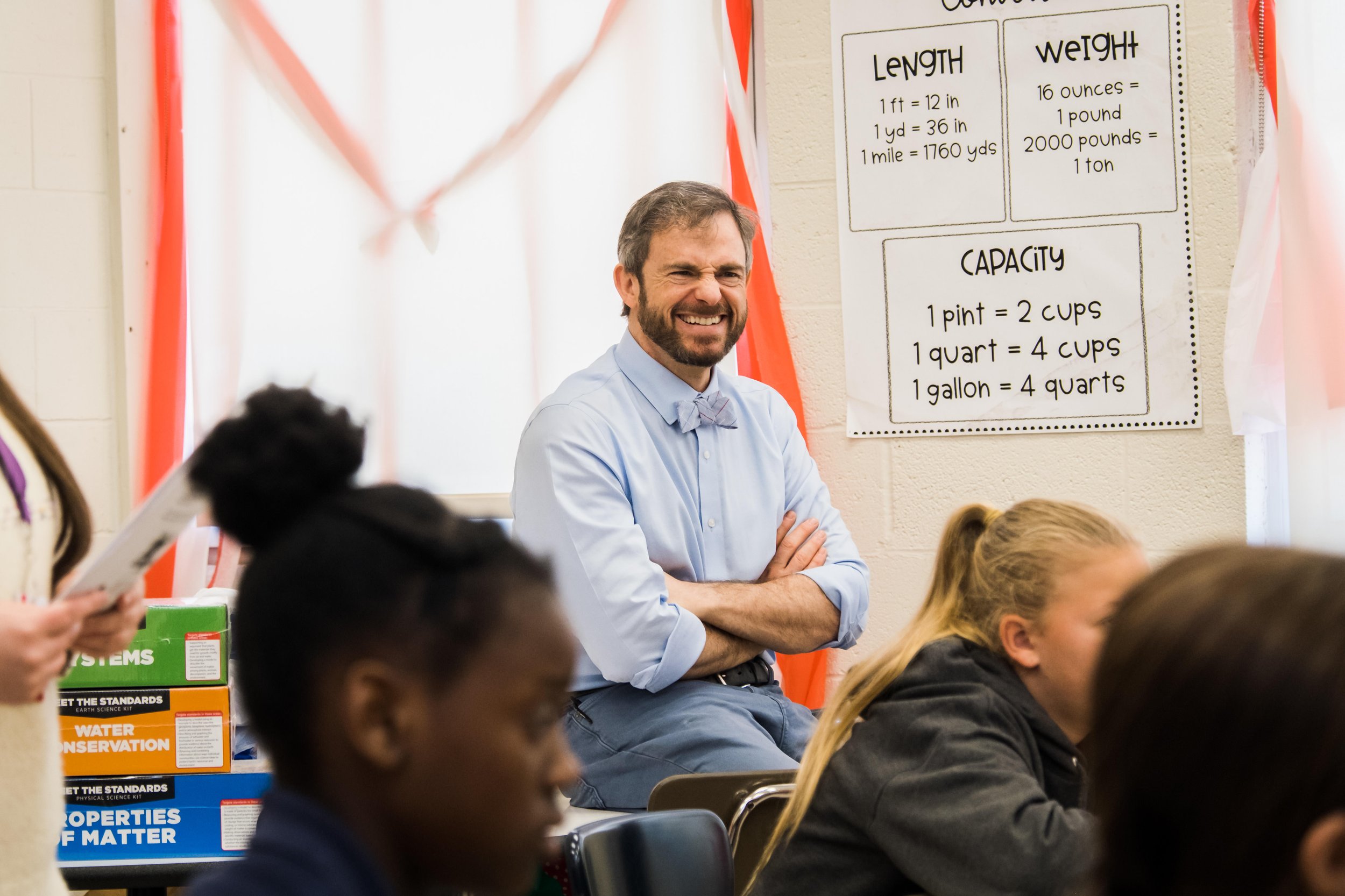
Joe Ross, president of Reach University, visiting Brusley Elementary School in Louisiana.
Philanthropy Roundtable recently highlighted Reach University’s impact beyond the classroom. The story was so informative, we decided to post it here. If you would like to learn more about Reach University, please contact Pathways to Opportunity Program Director Stephen Allison.
Written by Bekah Bibb and Francis Mizner
Joe Edelheit Ross still remembers the impact of his second grade teacher, Ms. Fenner, who instilled in him a lifelong appreciation of education.
“My mom, on the phone with my teacher in tears, said, ‘You passed the end of your reading assignment.’ I still remember Ms. Fenner, who invested in me and took me out of class to play games with me every day. As an adult, I realized she was doing a reading intervention even though she never let on,” Ross said.
“Not only did I learn to read, but I gained a tremendous amount of confidence. I graduated from high school and then attended Yale undergrad and Stanford Law School. Now, I’m president of a university, and I have to ask, would any of that have happened without her?”
This deep appreciation for teachers was the spark that helped Reach University expand nationally. Reach University is a nonprofit, accredited institution that helps working adults earn debt-free college degrees by integrating their jobs into their coursework through an apprenticeship degree. Instead of a traditional college model, students learn through paid apprenticeships coupled with a rigorous liberal studies program, making degrees more affordable, practical, relevant and accessible.
“All of us who started Reach University had someone like Ms. Fenner, and we saw all these millions of people who didn’t have a Ms. Fenner. We wanted to start there and give people power over their lives,” he said.
Possibilities Reimagined
“This is an opportunity that a lot of people would not be able to get otherwise. It’s all about whether you pick it up or not,” said Jackie Collins, a current Reach undergraduate pursuing her teacher apprenticeship degree.
As a working mother with an associate degree, Collins was ready to further her education. However, with high tuition costs, challenges in transferring previous credits and bills to pay, attending a traditional university was not an option. But after a Reach University representative spoke at an annual school district meeting, Collins realized she could turn her aspirations to become an educator into reality.
Ross saw firsthand the tough decision many adults like Collins were facing when it came to choosing education over their other responsibilities.
“A lot of people raise kids and don’t have the opportunity to leave their job, leave their home, leave their community, and certainly don’t have the capacity or desire to go in debt,” he said.
With Reach there is no difficult decision to be made. Instead, learners have the opportunity to pursue an education while supporting their families, and do so affordably.
“We set out to intentionally design radically affordable and workplace-based degree programs that turn jobs into degrees. And that model essentially means half the learning experience comes from work and the other half comes from inquiry-based seminars after work hours,” said Ross.
The program includes a career-focused liberal arts curriculum incorporating what each learner does in their day job with synchronous seminars led by professors who work in the field. The Zoom-hosted, human-to-human interactions offer flexibility, support and a sense of community to the program’s learners.
Collins, who explored other education models in the past, found the twice-weekly virtual seminars most effective for her.
“I have taken college courses online and you just watch a video and answer the questions. There was not a lot of interaction. But Reach is different. If you have questions in your Zoom class you can ask them, and instructors are there to help you with whatever you have trouble with.”
Affordable for all
At its core, Reach University is built on the belief that education should expand choice—not limit it. That belief is reflected in its model and the way it is funded through a braided model of Pell Grants, workforce funding and philanthropic donations to ensure learner affordability without debt. For philanthropic leaders, a donation of $2,000 covers an entire year of a Reach candidate’s education, leaving students to pay just $75 a month out of pocket. This is only possible with the gracious support of donors like Carrie Morgridge.
Morgridge and her husband started the Morgridge Family Foundation in 2008 to help organizations re-envision solutions to life’s most difficult challenges.
“When you see that Reach University has the potential to change thousands of organizations and lives, you know funding is the right thing to do,” said Morgridge.
Reach University currently has 3,400 enrolled students as a part of the Apprenticeship Degree Program and is seeing the ROI of their program in real time following the first set of graduates.
Over 84 % of Reach graduates were immediately promoted to teaching jobs in Arkansas. While some doubled their salaries from what they were making as teaching assistants, others tripled their yearly income.
An impact beyond the classroom
The goals for Ross and Reach have been to support the upward mobility of working adults and inspire others to expand access to higher education for working adults.
“There are 50 million working adults in this country who wish they had more education,” said Ross.
While colleges and universities pursue roughly three million high school seniors expected to graduate each year, the hopeful working adults are left behind.
Morgridge added, “The student who is going to Reach University might be between 35 and 50-plus years old, and Reach is meeting them where they are in life. … This degree is the key to unlocking their own pathway.”
Reach serves working adults left behind by traditional pathways. The apprenticeship degree allows them to accomplish things they did not know were possible.
“I limited myself on what I believed that I could and couldn’t do, and so, this has opened my eyes to have a different mindset to reach my goals. I feel empowered,” said Collins.
Not only are students seeing the payoff, but employers are as well.
“I hear often with employers that first-year professionals who came through our program are demonstrably better than first-year teachers who came from traditional pathways,” Ross said.
What’s next for Reach
As exciting as the present is, Reach University has its eyes set on the future.
In early 2026, Reach will launch the country’s first Apprenticeship College of Health (ACH), demonstrating replicability through an exemplar program. ACH will start with a behavioral health associate degree, with plans to launch additional bachelor’s and master’s degree offerings, subject to accreditor approval.
Like the teacher shortage, the Health Resources and Services Administration predicts a shortage of nearly 88,000 mental health counselors and 114,000 addiction counselors by 2037.
“There are frontline and behavioral health employees working as community health workers, case workers or peer counselors. If they had the right training, the right degree, they could rise and become licensed clinical counselors and help solve the mental health crisis in this country,” said Ross.
Reach has also launched the Classical Liberal Arts, Science and Society Institute or CLASS Institute. The purpose of this initiative is to embed liberal arts, AI and critical STEM skills in all the occupations learners pursue through Reach, ensuring long-term flourishing in life and career.
Lastly, with the help of the Morgridge Family Foundation, Reach will further expand its National Center for the Apprenticeship Degree (NCAD) to amplify its role as the apprenticeship degree field-intermediary and backbone for peer institutional adoption. This program brings together colleges and universities that are also building work-based degrees in a broad swath of industries, such as education, health care and more
“I absolutely love NCAD and how Reach is tackling two of America’s largest problems right now, which are shortages in teachers and health care workers. Reach is addressing both of those without putting people in student loan debt,” said Morgridge.
At the University of Wisconsin (UW) Health System, one of the nation’s leading apprenticeship degree providers, the health care students will graduate with 1,000 hours of hands-on experience. “Can you imagine what an advantage it is to graduate with more hands-on hours than what is required for your degree? This is while you have your full-time job, and are able to provide for your family?” said Morgridge. “The model is so incredibly brilliant, it’s almost too good to be true. But then you meet the students, and it’s not too good to be true. It’s working.”
More work lies ahead for Ross and his nationally-reaching faculty and team. But with the help of philanthropists to partner with them, this model has the potential to reach more than just the 10 states it currently serves.
“These are not one-off miracles, but … a change that can happen across the country. We’re already serving 3,500 adults, nearly all frontline roles, and we are ready to grow our reach to 10,000 candidates across 20 states over the next couple of years,” added Ross. “Beyond our direct service offerings, we’re also positioned to support dozens of additional colleges and universities in adopting their own apprenticeship degree programs, demonstrating further sustainability and replicability across sectors. We’re taking meaningful steps toward creating a national tipping point — but need the support of philanthropic leaders to achieve our near-term goals of validation, scale and replicability.”
For Ross, Collins and the thousands of working adults Reach serves, the mission is clear. Education should meet people where they are, honor the work they already do and empower them to shape what comes next. With continued support, Reach University isn’t just redefining higher education, it’s proving that opportunity, when made accessible, can transform communities far beyond the classroom.
Related Stories