
Rethinking childcare in Big Sky
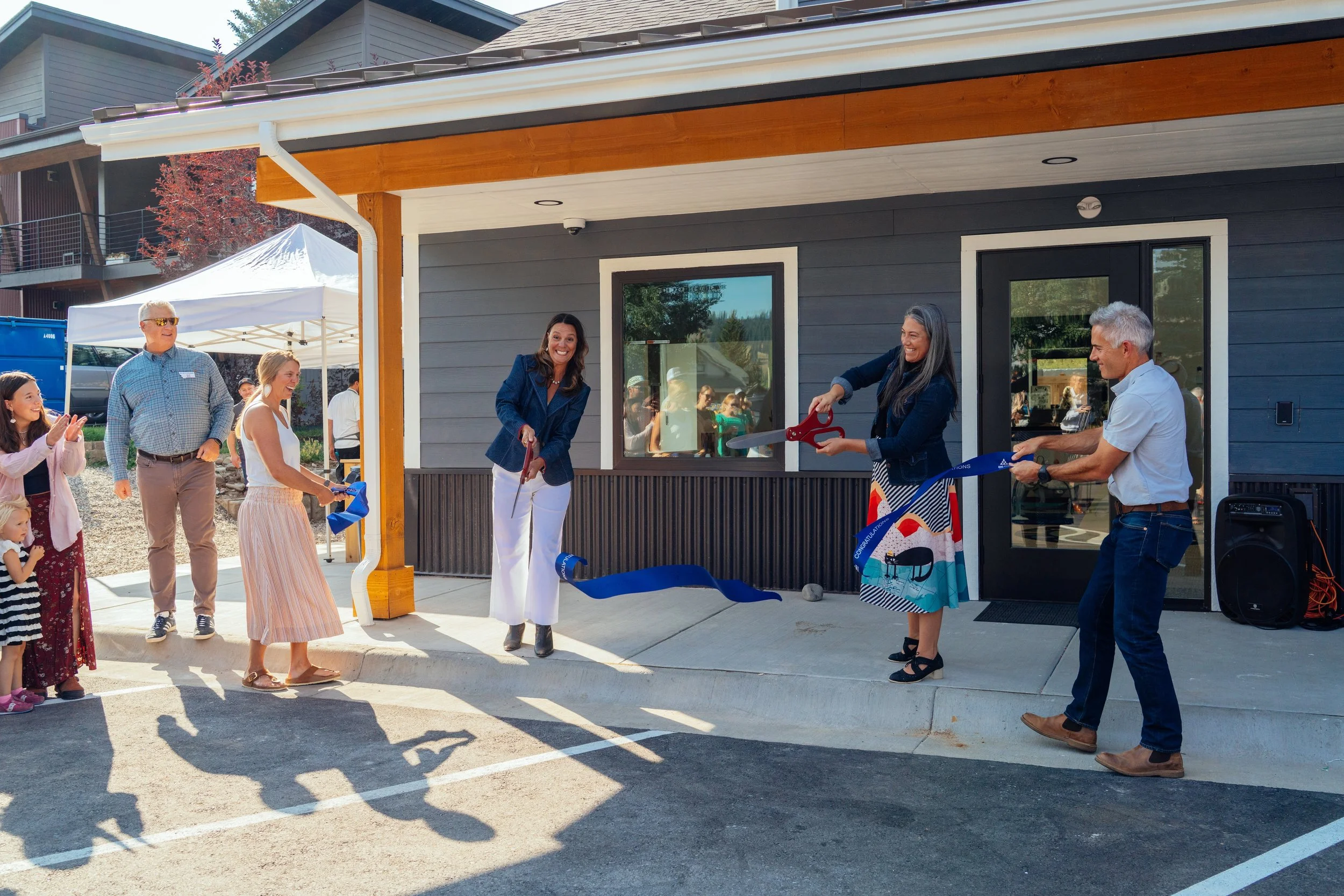
Ribbon cutting ceremony with Yellowstone Club Community Foundation at the Gallatin Child Care Center.
Written by Ciara Wolfe, Vice President of Philanthropy, Yellowstone Club Community Foundation
In Big Sky, Montana, and across the country, childcare isn’t just a family issue; it sustains the economy, supports the growth and sustainability of entire communities, and helps ensure that communities thrive.
Historically, childcare has been rigid and inaccessible for many parents who work long hours, weekends, and holidays. They often discover that traditional childcare centers are closed on days they have to work.
Big Sky drives a massive 4% of Montana’s entire GDP. We are a premier economic engine for the state, responsible for one in three jobs in nearby Bozeman. Yet those numbers only paint half the picture.
On the other side, our local high school class sizes are in the 30s, but our kindergarten classes drop into the teens. Why? For years, we have watched young families pack up and move away when they consider having children.
In Big Sky, 96% of women are in the workforce, compared with 66% in nearby Gallatin and 51% in Madison. Dual incomes make it viable to live here at all. Yet the average annual cost of childcare in Big Sky has soared to $20,795—more than double the Montana state average and more than the cost of in-state college tuition. To make matters worse, our state’s childcare subsidy program, Best Beginnings, doesn’t work for us. Our local wages are technically “too high” to qualify, but when a family is paying resort-market rent or mortgages, the need for affordable childcare options is imperative.
Families feel trapped, forced to choose from only one care option that offers limited hours and has waitlists of up to 50 children.
At the Yellowstone Club Community Foundation (YCCF), we decided it was time to stop talking about the “childcare crisis” and start building our own system that reflects how our community lives and works, investing in the infrastructure that supports its people.
We believe it takes courage to have big ideas and even more to see them through, and we want to fundamentally reimagine what it means to live and work in this community.
We recognized that the traditional model was failing our workforce, so YCCF took a bold step: we purchased and completely renovated an existing building, opening a childcare center in less than a year. It serves children ages 0–3, is open from 7 a.m. to 7 p.m., offers weekend availability during key times, and is closed only eight days a year.
YCCF owns the building and provides it to the programs at no cost, aiming to reduce administrative overhead and allow the centers to pay higher wages to teachers, thereby strengthening the quality of care.
We are so grateful to partner with Morgridge Family Foundation, who can truly see our vision for childcare and has joined us in this initiative with a transformative $5 million investment. While $1.2 million will support families immediately, the remainder establishes the MFF Elevate Endowment to ensure that early childhood education in Big Sky remains available to all who need it. Through income-based scholarships and expanded care options—such as bilingual classrooms—we are ensuring that every family has access to quality options.
We want to use what we have learned at our current facility and apply it to the next phase, too, where we plan to build a new, much larger Early Learning Center that will serve up to 150 children and house multiple programs under one roof.
This work is also part of a broader vision for Big Sky.
We’re moving toward becoming a year-round community, and childcare is a key part of that, alongside housing. Currently, major housing developments are underway that will bring more affordable workforce housing, and we see these efforts as directly linked. You cannot have a thriving town with housing but no childcare, nor can you have childcare without somewhere for people to live.
Big Sky is a significant driver of Montana’s economy, but more importantly, it’s a place where people want to build their lives. For that to be possible, we need systems that support them, and we believe that if we do it right, people will stay. More families will choose to come. There will be more job opportunities. Schools will become more sustainable. And the community becomes stronger as a whole.
The impact is profound. Nationally, early childhood education offers the highest return on investment—up to $18 for every $1 spent. For us, the return is the sounds of a thriving school system, the stability of a dual-income household, and the gift of a community investing in its future.
At YCCF, we are proud to lead the charge, and this is just the beginning. It’s a heavy lift, requiring the dedication of all of us—donors, volunteers, and the community—to bring this project fully to life. If we can build a sustainable and accessible model with how people actually live and work, it can serve as an example for other communities and ensure that all people can have the life they want.
Related Stories
![Announcing the Solv[ED] Youth Innovation Challenge](https://images.squarespace-cdn.com/content/v1/679a84e2f30b4447fcc25171/6f8cf2e1-f2f3-483c-93b2-560b8512e1b6/mimi-thian-slWBjTGhREQ-unsplash-scaled.jpg)