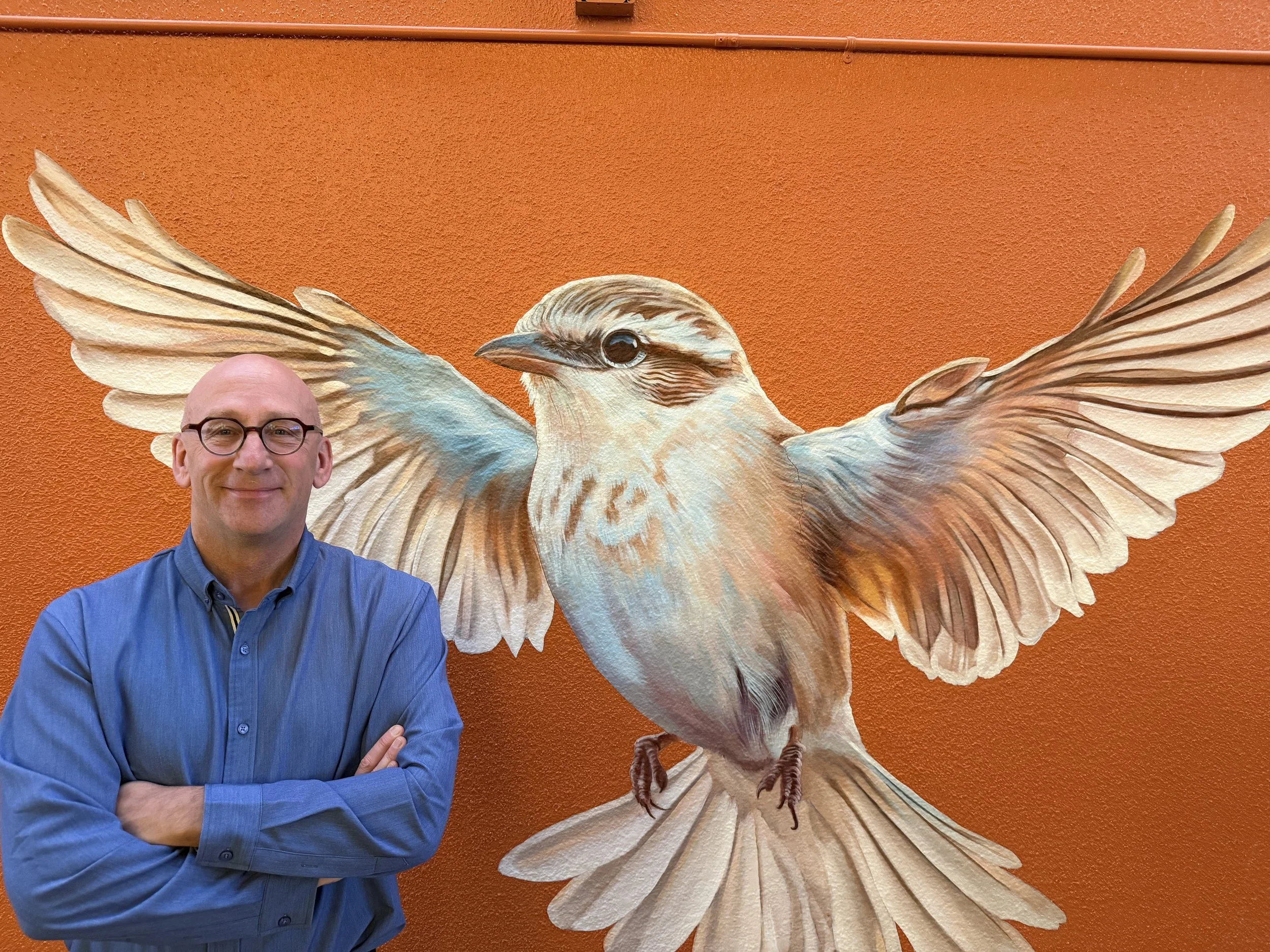
Jim Goebelbecker, founding CEO and president of Advance Pathways
Jim Goebelbecker knew early on that he wanted to make an impact. After college, he co-founded an employment agency for homeless men in Phoenix. Over the next 30 years, he gained important skills and experience in higher education, at a technology start-up, at other nonprofits, and as a leadership coach. He earned an MBA and later a PhD in human and organizational systems. Now he’s using everything he’s learned, as founding CEO and president of Advance Pathways, a nonprofit that helps homeless adults move toward self-sufficiency in independent housing while gaining livable-wage employment.
Last year, Advance Pathways won the competitive bid to operate a new kind of shelter that changes the way homelessness is addressed in Aurora and surrounding communities in Southeast Denver. The 13-acre Aurora Regional Navigation Campus opened in November 2025 and is funded by the city of Aurora, along with government and nonprofit partners, including the Morgridge Family Foundation.
We checked in with Jim to see how the start-up phase is going and how they will measure success.
Homelessness is such a complex issue in Denver and across the country. What led you back to this work after such a varied and interesting career?
Advance Pathways’ combination of housing, wrap-around services, and economic opportunity was intriguing, and I wanted to help bring the vision to fruition.
How is the new Aurora Regional Navigation Campus model different, and are there other projects like it in other cities?
To our knowledge, there is no other model like the one at the Navigation Campus, at the scale we are providing. We don't consider ourselves a typical shelter, but instead a program that requires participation. What makes it unique is a three-tier system for housing, where people are rewarded for setting and moving towards their goals.
How do the tiers work?
Tier 1 is emergency housing. Anyone can come in off the streets and access one of the 285 cots. Tier 2 has 114 beds and is for those individuals who have engaged with a case manager and want to pursue a workforce program. In Tier 3, there are about 218 private rooms. To live there, a person has to be sober and have a tax-paying job. People can enter the facility at any tier, and they can “earn their way forward.”
Housing-first and work-first are two fairly different strategies for addressing homelessness today. How do you see the differences? Can they work together?
Yes. The Navigation Campus is essentially both: Housing-first for anyone coming in off the streets, and work-first for Tier 3. In Tier 2, we offer a program called WorkBridge, which teaches life skills and skills to support finding employment. We believe that people who are motivated to change their current condition can be supported to make a move towards a life that puts homelessness in their past.
What else makes the Aurora project unique?
In addition to the tiered housing, we also offer “respite beds” for local health care systems to discharge patients to a safe place. We hope this will avoid repeat visits to the emergency room. In the future, we plan to have a health clinic.
We also have a Navigation Center. This is a central place where our community partners who provide workforce development services, government assistance, case management, and other services can meet with our unhoused guests. Having a singular location for multiple services eliminates the need for our residents to take buses to different locations around the city. Thanks to the Morgridge Family Foundation, we were able to furnish the Navigation Center, which includes four training rooms, nine private offices, and a reception area.
As can be expected, the project has faced some early challenges. But you’ve also seen some great success. Can you talk about that?
Launching a campus in a repurposed, decades-old hotel is not simple. While we built case management teams, hired and trained staff, implemented safety protocols, and served individuals in crisis, we also had to coordinate plumbing repairs, security upgrades, construction delays, and phased service rollouts with the city of Aurora. Some issues were anticipated; others were not. Facility operations at this scale are complex, and we are happy that the facility is now operating more smoothly.
The campus has already become a lifeline for hundreds of men and women — providing shelter, stability, and coordinated support to people who desperately need help. Roger and his wife Lisa are a great example. Roger spent months staying awake on the streets to protect Lisa, whose serious health challenges and limited vision made traditional shelters impossible. At the Navigation Campus, Roger can finally sleep while Lisa receives consistent medical care. They dream of having a small piece of land, a cabin, and a garden where she can grow flowers. That dream reflects what this campus is truly about: creating dignity for people, not dependency.
Stories like theirs and so many others keep us focused on the potential for positive impact for our unhoused guests, which will be built through persistence, course correction, and sustained community commitment.
As a public-private partnership, how will the project be funded?
In addition to the City of Aurora, which provides about $2.3 million, we rely on the generosity of foundations, individuals, corporations, and Medicaid billing to underwrite the $11 million budget. We anticipate the first couple of years to be very important for foundations to support our efforts as we then build out the individual donor database.
What will success look like, and how soon will you know if the project is working?
We focus on capturing data on the movement forward for the people we serve. We will know we are successful when we see a consistent flow of people from Tier 1 into Tier 2, and eventually when we have 150 or more previously unhoused adults, who are living in Tier 3 while employed, earning a thriving wage, and with a plan to move into independent housing.
What do you need most right now to make the project sustainable?
What we need most right now is the financial investment from foundations and individuals who believe in supporting bold initiatives that fuel self-determination. We are also expanding our local volunteer team to help out at the campus. More information can be found here.
Related Stories